banner

Home | Personnel | Research | ODC | Spotlight | Affiliates | Outreach | News | Links


logo


Productivity and Ocean Color

Our working group consists mainly of phytoplankton ecologists who wish to understand the fundamental question: what controls phytoplankton growth and distribution in the ocean? More specifically, how do the multiple interactions of light, macro- and micronutrients and phytoplankton physiology determine the rates, processes, and patterns that we observe in the marine environment? Oceanography is rapidly moving away from observational science towards an understanding of underlying mechanistic processes at all scales, in part because of the wealth of revolutionary new technological and scientific advances such as access to ocean color data from satellite sensors. Our approach is to combine a suite of three tools:

(1) remotely sensed data from moorings and satellites in combination with biological models

(2) novel bio-optical methods assaying phytoplankton physiology

(3) the refinement of stable and radio-tracer isotopes.

By integrating these methods, we can begin to use ocean color to answer important ecological questions.

More about ocean color

More about phytoplankton ecology

More about CO2 analysis - the Kudela lab is now measuring carbon dioxide at the Santa Cruz Wharf! This is an exciting addition to existing observations of temperature, salinity, phytoplankton species, chlorophyll, nutrients, toxins, optical properties, and meteorology.

Tools, equipment and techniques

Research Projects

NASA Water Quality

Summary

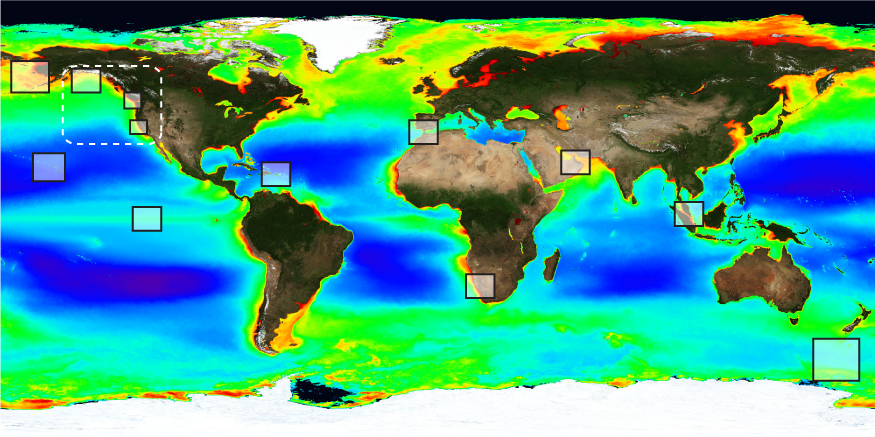
Goal: to use satellite data in combination with numerical and statistical models to address first-order questions about water quality within the California Current System. We will demonstrate that a combined approach wherein satellite data are merged with numerical model simulations can provide the spatial and temporal coverage necessary to quantitatively predict water quality (Harmful Algal Blooms and hypoxia, respectively) for Southern California and the Pacific Northwest Shelf.


California Sea Grant

Forecasting Domoic Acid Production in Coastal California

Focus Award

Goal: to examine the factors that control the toxicity of Pseudo-nitzschia cells in Monterey Bay. We
hypothesize that toxicity is controlled by the dynamic adjustment to macronutrient availability and its effect on Pseudo-nitzschia physiology. Our primary objective is to test our hypotheses via the development of a mechanistic model of DA production that incorporates ecophysiological principles and can be evaluated against observational
data from prior laboratory studies and from “first flush” events in the Monterey Bay.


ECOHAB/OCSD

http://coastalscience.noaa.gov/news/coastal-pollution/california-hab-project-well-timed-to-study-impacts-of-sewage-ocean-outfall-diversion/

The Plume Effect

The concurrence of an ECOHAB project, comparing the effect of natural sources of nutrients versus those derived from human activities (runoff or sewage) on the development of Pseudo-nitzschia and other HAB species along the California coast, with a sewage diversion project in Orange County represented a unique opportunity to investigate the impact of large increases in nutrients derived from treated sewage on a natural ecosystem.

Goal: To investigate the impact of large increases in nutrients derived from treated sewage on a natural ecosystem and make measurements before, during, and after a bloom.


MB 11 - COAST-HOPE

http://geo.arc.nasa.gov/coast/coast_index.html
http://128.114.198.239/packages/9

Goal: MB11/ COAST-HOPE is a collaborative effor with NASA to understand the physical, chemical, and biological workings of Monterey Bay, and understand what produces massive red tides during the months of September and October. Novel sensors and new techniques are used to investigate the conditions that lead to a bloom event. For more about this year's project, click here.


Predicting Harmful Algal Blooms in Coastal California

http://www.csgc.ucsd.edu/NEWSROOM/NEWSRELEASES/2010/PredictAlgalBlooms.html

Goal: to implement existing HAB models from Santa Barbara and Monterey Bay previously developed as research exercises, to test and expand these existing models in other regions, to begin developing a similar modeling effort for paralytic shellfish poisoning, and to provide consistent field monitoring and validation data to adequately assess the model results.

Lab contact: Raphe Kudela, Clarissa Anderson


Santa Cruz Ocean Observing Platform

http://oceandatacenter.ucsc.edu/SCOOP/

Goal: To monitor atmospheric and oceanic conditions in Monterey Bay, in order to better understand, detect and predict Harmful Algal Blooms. In the future, the SCOOP system may be used as a prototype for the development of oceanographic monitoring stations in other locations.

Lab contact: Kendra Hayashi, Anna McGaraghan


Persistence and Fate of Domoic Acid in the Santa Barbara Basin

http://www.nsf.gov/awardsearch/showAward.do?AwardNumber=0850425

Goal: To create a regional observation and modeling program focused on the Santa Barbara Basin (SBB) that specifically: 1) Examines the temporal relationship between Pseudo-nitzschia blooms, DA toxicity, and the vertical transport efficiency of Pseudo-nitzschia and DA to the benthos, 2) Investigates the incorporation of DA into the sediments, and 3) establishes a historical record of DA toxicity spanning the past decade, and potentially, the last century.

Lab contact: Clarissa Anderson


ECOHAB

Ecology and Oceanography of Harmful Algal Blooms

http://www.cop.noaa.gov/stressors/extremeevents/hab/current/abs_ECOHAB.aspx#PNWTOX

Goal: To improve predictability of Harmful Algal Bloom (HAB) events on Pacific Northwest (PNW) coastal beaches by advancing our understanding of HAB development/dissipation and transport and mixing processes using existing data in parallel with state of the art physical and bio-physical models that include, for the first time, both the Columbia River (CR) plume and potential HAB source regions off both Oregon and Washington.


Click here to view completed projects


University of California Santa Cruz
Ocean Sciences Department
Santa Cruz CA 95064