This page provides supporting information and ancillary data for the manuscript "Bilateral Mastoiditis from red tide exposure"
Last updated: 10 February 2010
Authors: Samantha Honner, MD (1), Raphael M. Kudela, PhD (2), Ethan Handler, MD (3)
1. Department of Emergency Medicine, Kaiser Permanente Oakland Medical Center, Oakland, California
2. Ocean Sciences and Institute for Marine Sciences, University of California Santa Cruz, Santa Cruz, California
3.Department of Otolaryngology, Kaiser Permanente Oakland Medical Center, Oakland, California
ABSTRACT (from the submission):
A 53-year-old female presents to the emergency department with bilateral otitis externa and mastoiditis after scuba diving during a harmful algal bloom, commonly known as a “Red Tide”. This is the first reported case of bilateral mastoiditis in a healthy adult. Harmful algal blooms are associated with elevated bacterial counts and may account for this unusual infection.
Field Collection Methods:
Data from 2006-2009 were included in this analysis, subset by season. Data were obtained from a time-series at the Santa Cruz Municipal Wharf, and from the Monterey County Health Department, Division of Environmental Health. Sampling at the Santa Cruz Municipal Wharf consisted of approximately weekly sampling of surface water approximately 100 m offshore (10 m water depth). Samples included total chlorophyll, fecal indicator bacteria, picoplankton and heterotrophic bacteria cell counts, and phytoplankton species composition (to species where possible, to genus or functional group for rare/unusual organisms). All analyses followed standard protocols. Original data are available online at http://cimt.ucsc.edu:8080/dods/cpmt/.
Monterey County data were collected approximately weekly from several beaches. Additional details are available at http://www.co.monterey.ca.us/health/beaches/
Fecal indicator bacteria for all stations are reported as Most Probable Number (MPN) per 100 mL seawater. Samples were analyzed using commercially available kits (IDEXX Laboratories Colilert, Enterolert). Bacterial samples from Santa Cruz Municipal Wharf were additionally analyzed for total heterotrophic bacteria (cells/mL) by quantitation with SYBR Green DNA probe and analysis on a Cytopeia Influx flow cytometer.
Statistical Methods
Bacterial counts and chlorophyll data were log-transformed. Statistical analyses were performed using the MyStat package, with a significance level of p<0.05. For correlations, standard linear regression was used. ANOVA with Tukey HSD post-hoc test was used for identification of significant relationships among variables.
Extended Results
The findings presented in the manuscript were based on analysis of the field data, linking heterotrophic bacteria and fecal indicator bacteria to the prevalence of red tide forming dinoflagellates. Initial analysis of all data (2006-2009) showed no statistically significant relationship between dinoflagellates and bacteria, likely because of the strong seasonality present in both variables. Subsequent analyses partitioned the data by season, with emphasis on the autumn (July-November), when the reported ear infection took place.
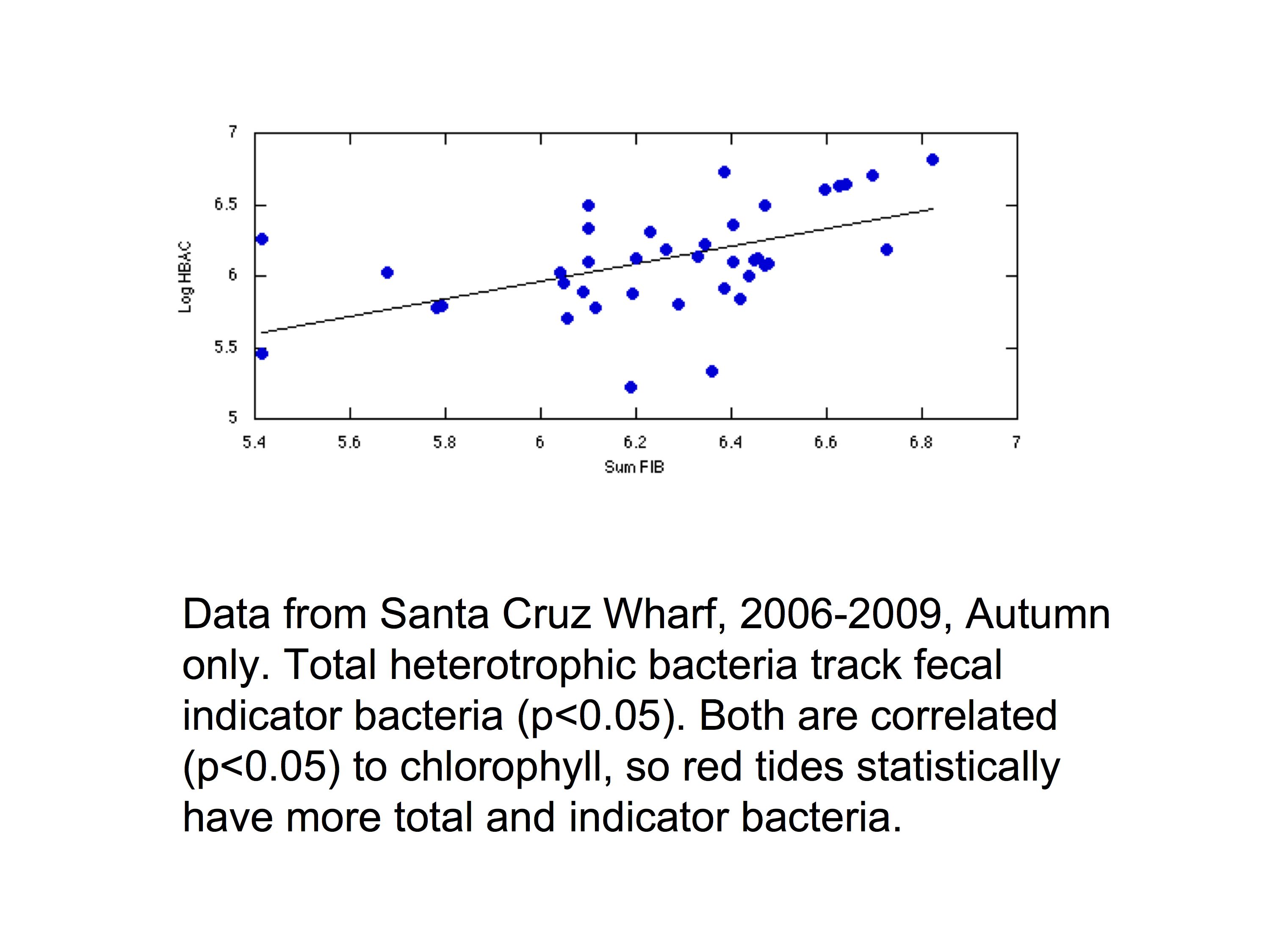
During autumn, there was a strong, positive relationship (p<0.05) between total chlorophyll and dinoflagellates. Extreme chlorophyll levels were always associated with red tide forming dinoflagellates. Total heterotrophic bacteria were positively correlated with fecal indicator bacteria (Figure 1), and both data sets were positively correlated with total chlorophyll. We concluded that bacteria, including potentially human-pathogenic bacteria, were more prevalent during periods of red tide in Monterey Bay coastal waters.
Analysis of bacterial data from Lover’s Point Beach (the nearest sampling location to the reported incident) indicate that there were very high levels of Total and Fecal Coliform immediately prior to the incident, in mid-September, 2009 (Figure 2). Comparison of these data to the longer time-series (2006-2009) indicates that this level of indicator bacteria was unusual, with similarly high levels occurring in autumn 2006 and 2008, also during periods when red tides were observed in Monterey Bay.
For 2009, from all Monterey County beaches, there were a total of 16 regulatory exceedences (>104 MPN/100mL for Enterococcus), clustered between July and the beginning of November, strongly suggesting that nearshore water quality was impacted in the southern Monterey Bay region during a period of prolonged red tides.